



Modern commercial aviation demands absolute structural integrity and ultimate operational safety. Advanced aerospace fasteners production technologies eliminate disastrous hardware failure in flight. Consequently, aircraft manufacturers maintain strict lead-free compliance and extreme fatigue resistance. Furthermore, precision alloy processing replaces traditional loose fastening assemblies. Therefore, aerospace engineers safeguard modern airframes against catastrophic vibration loosening.

Hazardous Scenarios in the Field of Aerospace Structural Fastening
Extreme Engine Vibration and Joint Self-Loosening
Continuous turbine vibration causes standard threaded hardware to back out. In addition, loose structural joints trigger severe mechanical wear. As a result, unsecure airframe components compromise passenger safety.
Thermal Fatigue and Severe Material Wear
Extreme altitude temperature swings weaken conventional fastener metallurgy. Furthermore, repeated thermal expansion cracks uncertified structural bolts. Consequently, maintenance crews replace damaged hardware during costly overhauls.
Insufficient Bearing Surface in Lightweight Assemblies
Standard narrow nut bases concentrate heavy mechanical stress locally. In addition, uneven stress distribution deforms delicate composite structures. Therefore, aircraft assembly lines require wider load-bearing flange nuts.
Technical Solutions Driven by Advanced Production Technologies
DIN 6923 Precision Flanged Nylon Insert Lock Nut Technology
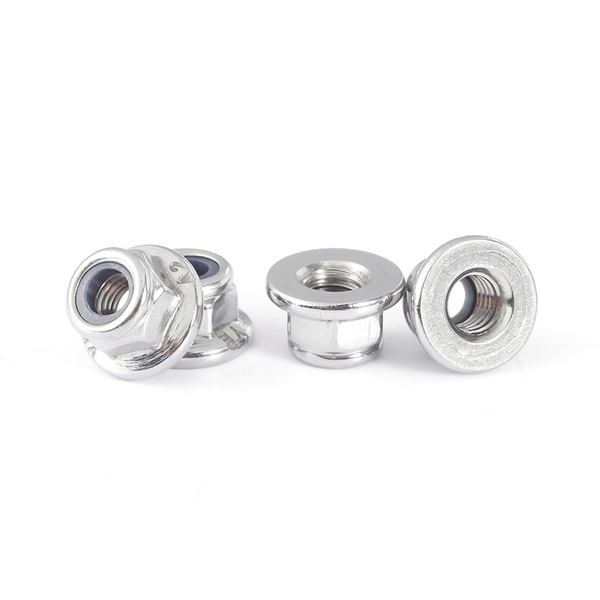
Advanced aerospace fasteners production technologies incorporate integrated nylon locking elements. Specifically, our DIN 6923 flanged lock nut prevents vibration self-loosening. Thus, the nylon insert grips mating threads under intense dynamic stress. For additional locking hardware options, Explore Our Aviation Locking Fasteners.
Flanged Base Design for Optimal Load Distribution
The wide flanged base spreads heavy joint clamping forces evenly. Furthermore, this design provides superior surface stability across thin materials. Consequently, engineers protect fragile aircraft structures during high-torque tightening. You can analyze detailed structural torque parameters in our Read Our Complete Fastener Engineering Guide.
High-Grade Material Compatibility and Cleanroom Preparation
Our vibration-resistant fastening solutions match perfectly with 304 bolts and flat washers. Moreover, factory cleaning removes oil and contaminants for immediate assembly line deployment. Therefore, maintenance technicians install reliable hardware without extra degreasing steps. Discover more industrial fastening solutions at Browse Full Aviation Fastener Inventory.

Product Specifications and Certification Comparison
The table below compares standard fasteners against our DIN 6923 flanged lock nut system:
| Parameter / Feature | Generic Industrial Hex Nut | DIN 6923 Flanged Nylon Lock Nut |
| Locking Mechanism | None (Requires Lock Washer) | Integrated Nylon Insert Lock |
| Bearing Surface | Narrow Standard Face | Expanded Flanged Base for Stability |
| Vibration Resistance | Low (Susceptible to Back-Out) | Superior High-Frequency Resistance |
| Cleanliness Level | Standard Factory Oil | Pre-Cleaned for Immediate Use |
| Component Compatibility | Basic Hardware | Fully Compatible with 304 Bolts & Washers |
| Manufacturing Standard | General Commercial | DIN 6923 & ISO Aviation Grade |
Q&A
How do nylon inserts prevent fastener loosening during high vibration?
Nylon inserts grip bolt threads tightly to prevent vibration self-loosening. Consequently, they maintain constant clamping pressure during rough flights.
What advantage does a flanged base offer over standard flat washers?
The flanged base distributes joint clamping stress over a larger surface area. Therefore, it prevents localized material deformation and joint crushing.
Are these flanged nuts compatible with standard 304 stainless steel bolts?
Yes, our DIN 6923 flanged nuts seamlessly pair with 304 bolts and flat washers. Thus, they ensure full dimensional compatibility across structural assemblies.
Why are aerospace fasteners production technologies critical for flight safety?
Advanced manufacturing ensures exact thread tolerances, zero contamination, and high fatigue resistance. Consequently, modern aircraft maintain structural safety under harsh operating conditions.